Plant Care
How Much Light Do Houseplants Really Need
Learn houseplant light requirements by type, how to measure light indoors, and which plants thrive in each window direction.
Light is the single variable most people underestimate. A plant can survive underwatering for weeks, but put a sun-loving species in a dark corner and it declines in days. This guide breaks down what "bright indirect light" actually means in real rooms, how to figure out what your windows are giving you, and which plants fit which conditions.
At a Glance
- "Bright indirect light" means strong, diffuse light with no direct sun landing on the leaves, typically 1-4 feet from a south or west window.
- South-facing windows give the most light over a day; north-facing windows give the least and suit only genuinely shade-tolerant species.
- The shadow test (hold your hand a foot above white paper at midday) tells you your light level in about ten seconds, no equipment needed.
- Light drops sharply in winter as the sun's arc lowers; a spot that's bright indirect in July can be medium light by December.
- Etiolation (leggy stems, small new leaves, stretching toward the window) is the clearest visual sign a plant isn't getting enough light.
- Grow lights are a legitimate substitute for window light, not a last resort, as long as intensity (PPFD) and run time match the plant's needs.
What Do Light Terms Actually Mean
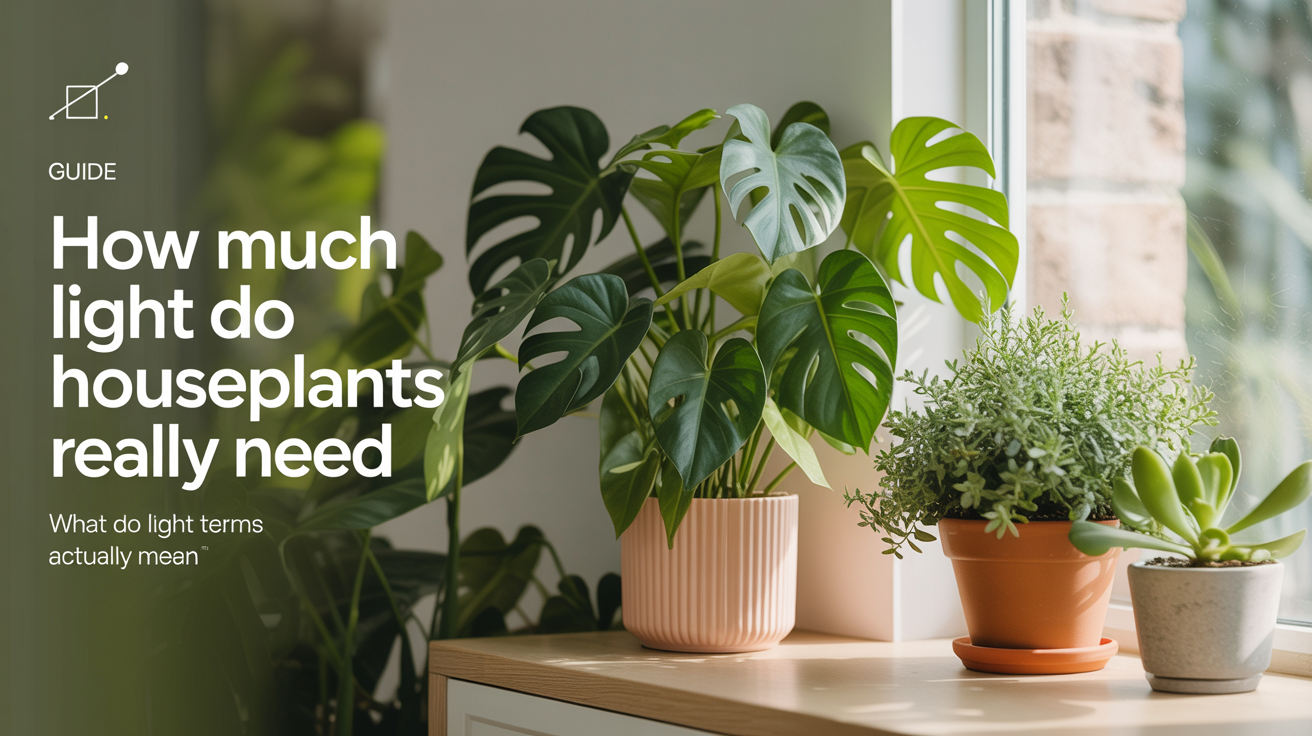
Garden centers and plant tags throw around terms like "low light" and "bright indirect" without defining them. Here's what they mean in practice.
Bright Indirect Light
This is the sweet spot most popular houseplants want. It means the plant receives strong light, enough to cast a soft shadow, but the sun's direct rays never land on the leaves. A spot a few feet back from a south- or west-facing window, or right next to an east-facing window, typically qualifies. Monsteras, pothos, peace lilies, and most aroids prefer this.
Direct Sun (or Bright Direct Light)
Direct sun means sunlight physically touches the plant. Outdoors, this is easy to spot. Indoors, it happens when a plant sits in or very close to a window facing south or west, with no sheer curtain filtering the beam. Succulents, cacti, and most herbs need this. Many tropical foliage plants will scorch here.
Medium Light
A few feet from an east-facing window, or back from a bright window with a sheer curtain, counts as medium. Snake plants (Dracaena trifasciata), ZZ plants, and pothos handle this well. Growth slows compared to bright indirect but the plants stay healthy.
Low Light
"Low light tolerant" does not mean no light. It means a plant can survive with the equivalent of a north-facing window, visible sky but no direct rays, or a spot several feet from any window. Cast iron plants (Aspidistra elatior) and some dracaenas are genuine low-light survivors. Most plants sold as "low light" are really medium-light plants that tolerate shade; they'll grow slowly and may struggle to stay lush long-term.
How to Measure Light for Plants Without Guessing
You don't need a light meter to get a reasonable read on your indoor light levels, though a cheap lux meter (under $20) takes the guesswork out completely.
The Shadow Test
Hold your hand about a foot above a white sheet of paper in the spot where you plan to put your plant, around midday on a clear day.
- Sharp, defined shadow, bright direct or bright indirect light, depending on whether sun is hitting you directly
- Soft shadow with blurry edges, medium light
- Barely-there shadow, low light
Lux and Footcandle Ranges as a Reference
Different extension services and grow-light manufacturers use different units, which is part of why plant tags feel inconsistent. Lux and footcandles both measure light intensity; roughly 10.8 lux equals 1 footcandle.
| Light Level | Lux Range | Footcandle Range | Typical Location |
|---|---|---|---|
| Bright direct | 20,000–50,000+ lux | Over 1,000 FC | In a south window, midday |
| Bright indirect | 5,000–20,000 lux | 500–1,000 FC | 1–3 ft from south/west window |
| Medium | 1,000–5,000 lux | 100–500 FC | East window or back from bright window |
| Low | 100–1,000 lux | 25–100 FC | North window or interior rooms |
These bands are consistent with University of Maryland Extension's footcandle classification for houseplant light levels, which places anything under 100 footcandles in the low category and reserves "direct sunlight" for readings above roughly 1,000 footcandles.
Free lux meter apps on a smartphone are hit-or-miss, the camera sensor isn't calibrated for accuracy, but they're fine for rough comparisons between spots in the same room.
Track the Season
Light levels drop dramatically in winter. A spot that delivers bright indirect light in July may fall into medium territory by December, when the sun arc is lower and days are shorter. If you notice plants getting leggy or pale in late fall, they're not getting enough light anymore. A south-facing window becomes more valuable in winter; north-facing windows lose almost all usefulness.
How Window Direction Affects Indoor Light
Window direction is one of the clearest predictors of what light you're working with.
South-facing windows get the most light over the course of a day in the Northern Hemisphere. They deliver bright indirect light several feet into the room and direct sun right at the glass. Both University of Maryland and University of Minnesota Extension identify an unobstructed south-facing window as the strongest natural light source available indoors. South-facing window plants that thrive here include citrus, succulents, cacti, and most herbs. Large-leaf tropicals can work a few feet back.
West-facing windows receive intense afternoon sun, often harsh in summer. This suits plants that want direct sun but can mean heat stress for thin-leaved tropicals right at the glass. Afternoon light is also often hotter than morning light.
East-facing windows give gentle morning sun, which is direct but not intense. This is ideal for many aroids, ferns, orchids, and African violets. The light is direct at the glass but lower intensity than south or west exposures.
North-facing windows deliver only ambient sky light with no direct sun at any time of year. Stick to genuinely shade-tolerant plants: cast iron plant, certain ferns, and Chinese evergreens (Aglaonema). Expect slow growth even from these.
Obstructions matter too. A south-facing window partly blocked by a roof overhang, a large tree, or a building across the street can behave more like a west or even east window. Extension guidance on indoor lighting flags overhanging roofs specifically as a factor that can cut a south window's effective output well below what its orientation would suggest.
Signs Your Plant Is Getting Too Much or Too Little Light
Plants communicate light stress visually. Learning to read these signs saves a lot of frustration.
Too Little Light
- Leggy stems with long gaps between leaves (etiolation)
- New leaves smaller than old ones
- Pale or yellowing foliage, especially in plants that should be deep green
- Variegated plants losing their pattern (reverting toward plain green to capture more chlorophyll)
- Soil staying wet far longer than normal (the plant isn't growing fast enough to use the water)
If you're also noticing watering issues tied to slow growth, it's worth checking our guide on how often to water houseplants and how to tell when they actually need it.
Too Much Light
- Bleached or washed-out leaf color
- Crispy brown edges or tips, especially on thin-leaved plants
- Sunscald: pale or tan patches that appear where direct sun hit the leaf
- Soil drying out very fast (not always a problem, but track it)
A quick move 2–3 feet farther from the window usually solves mild overexposure within a few weeks as the plant pushes new, adapted growth.
Supplementing with Grow Lights
If your apartment lacks good windows, common in north-facing units or rooms with small windows, grow lights are a practical fix, not a gimmick.
LED grow lights have gotten cheap and effective. A full-spectrum panel or T5-style bar light running 12–14 hours a day can support most tropical foliage plants and even some fruiting herbs. Key specs to look for:
- PPFD (photosynthetic photon flux density): 200–400 µmol/m²/s for most foliage plants, 400–600 for fruiting herbs
- Color spectrum: "Full spectrum" or 3000K–6500K range is fine for most houseplants
- Distance from plant: follow the manufacturer's guidance; most LEDs need to be 6–18 inches from the canopy for effective output
University of Minnesota Extension's PPF-based classification puts low-light plants at 50–150 µmol/m²/s, medium at 150–250, and high-light species at 250–450, a useful cross-check if your grow light's spec sheet lists PPF or PPFD instead of the lux or footcandle numbers most plant tags use.
Plants under grow lights still follow the same care logic as those in windows. If the soil, roots, and container aren't set up correctly, more light won't fix those problems, see our article on the best soil for houseplants for the foundation that actually lets plants use the light they're getting.
Matching Common Houseplants to Light Conditions
Here's a practical reference for popular species:
| Plant | Minimum Light | Ideal Light |
|---|---|---|
| Pothos (Epipremnum aureum) | Low to medium | Bright indirect |
| Monstera deliciosa | Medium | Bright indirect |
| Snake plant (D. trifasciata) | Low | Medium to bright indirect |
| ZZ plant (Zamioculcas zamiifolia) | Low | Medium |
| Fiddle-leaf fig (Ficus lyrata) | Medium | Bright indirect, consistent |
| Bird of paradise (Strelitzia reginae) | Bright indirect | Direct or very bright indirect |
| Succulent (most genera) | Bright indirect | Direct sun |
| Peace lily (Spathiphyllum) | Low to medium | Medium to bright indirect |
| Orchid (Phalaenopsis) | Medium | Bright indirect, no direct |
| Cast iron plant (Aspidistra elatior) | Low | Low to medium |
Note: many popular houseplants are toxic to cats, dogs, and small children. Pothos, peace lilies, and ZZ plants all fall in this category. Verify a specific plant's safety with the ASPCA's toxic and non-toxic plant list before bringing it home; the list is searchable by species and lets you filter results specifically for cats, dogs, or horses.
Frequently Asked Questions
What exactly is "bright indirect light" and how do I find it in my home?
Bright indirect light means strong, diffuse light that casts a soft shadow but doesn't include direct sun rays on the plant. In most homes, this is found 1–4 feet from a south- or west-facing window, or directly beside an east-facing window. A sheer curtain over a south window can convert a direct-sun spot into bright indirect. When in doubt, do the shadow test described above.
Can I move plants to different spots seasonally?
Yes, and for most plants it's a good idea. In winter, move sun-hungry plants closer to your brightest windows. In summer, you can push them back a bit or add a sheer curtain if afternoon sun gets intense. A fiddle-leaf fig that hates being moved will protest if you relocate it every week, but a seasonal adjustment twice a year is manageable for most species.
My plant is stretching toward the window. Does that mean it needs more light?
Almost always yes. This stretching (etiolation) happens when a plant reaches toward the strongest available light source because it isn't getting enough where it sits. Rotate the pot a quarter turn every week or two so growth stays even, and if you can move it closer to the window or add supplemental lighting, do it.
Do grow lights work as well as windows?
For many plants, yes. The key is consistency, grow lights run on a timer, so plants get stable day length, which can actually produce steadier growth than a window where clouds and season shift the intensity. High-light plants like citrus or most cacti are harder to satisfy with typical consumer grow lights, but tropical foliage plants do very well under full-spectrum LEDs.
How does repotting affect how a plant handles light?
A plant that's recently been repotted is under mild stress and may handle light changes less gracefully for a few weeks. Hold off on moving a freshly repotted plant to a brighter spot right away. Give it a couple of weeks to settle, then make the move gradually. For a walkthrough on when and how to repot, see our guide on repotting a houseplant without killing it.
Can a plant get too much light even without direct sun touching it?
It's uncommon but possible in an unusually bright bay window or a spot right against a large, unobstructed south-facing pane, where reflected and ambient light alone can push well past what a shade-adapted plant is built for. If a plant is bleaching or scorching but you're certain no direct beam reaches it, the fix is the same as for direct overexposure: pull it back a couple of feet and reassess after two weeks of new growth.
Do all plants need the same day length, or just the same intensity?
Both matter, though intensity gets more attention. Most common houseplants are day-length neutral for general growth, meaning they don't need a precise number of hours the way some flowering plants do to bloom. That said, consistently getting less than 8 hours of usable light a day, whether from a window or a grow light, will slow growth and produce the same etiolation symptoms as low intensity, even if the light itself was reasonably bright while it lasted.