Styling & Display
How to Arrange Plants by Light and Height
Learn how arranging indoor plants by light requirements and height creates displays that look intentional and keep every plant genuinely thriving.
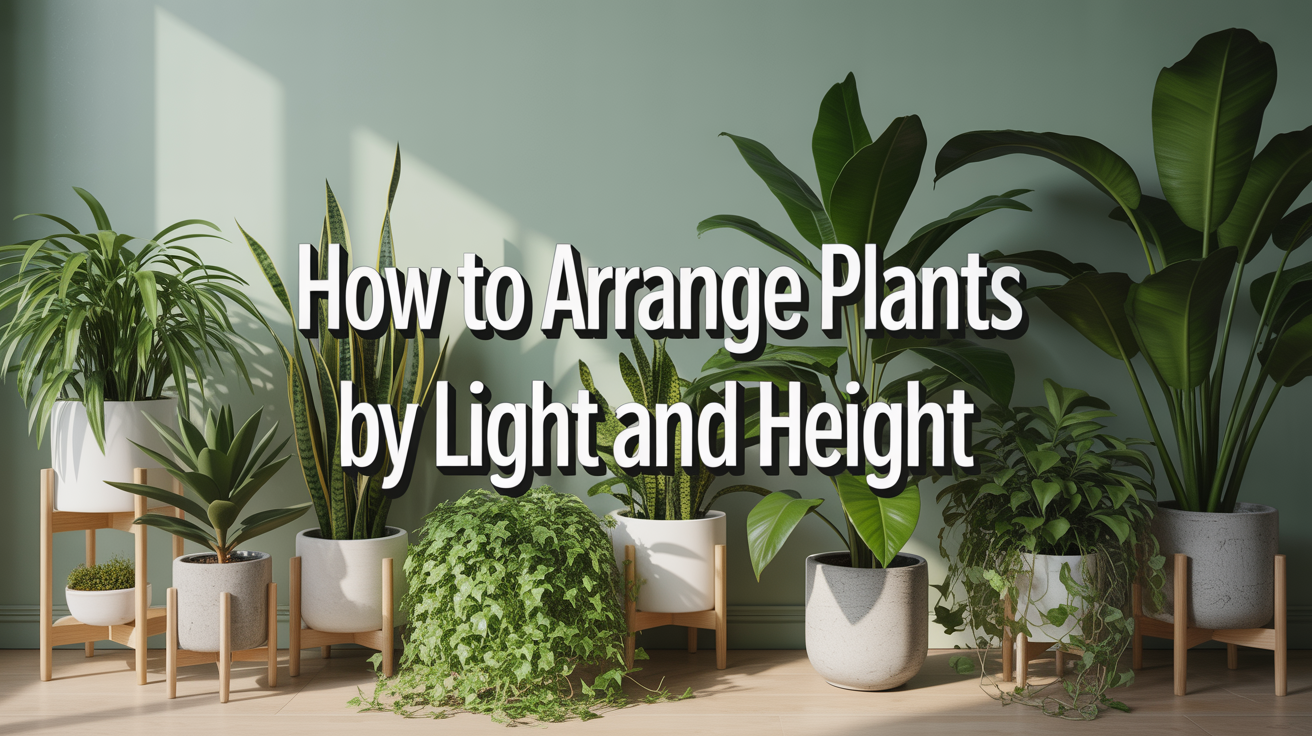
Most houseplant arrangements fail for one of two reasons: plants placed in light that doesn't suit them, or every pot sitting at the same height with no sense of depth. Fix those two things and the rest comes together surprisingly fast. Arranging indoor plants well is less about matching colors and more about understanding the practical constraints each plant lives under, then building a display that respects them.
At a Glance
- Map your light zones first (high, medium, low) before choosing where any plant goes; aesthetics come second.
- A soft-shadow "hand test" over white paper is a fast, free way to sort a spot into direct, bright indirect, or low light.
- Group plants by shared light needs, then vary height within each group so the arrangement has visual depth.
- Tall plants anchor the back or center, medium plants fill the middle, trailing plants soften the front edge.
- Rotate arrangements every 2-4 weeks so plants don't develop a permanent lean toward the light source.
- Repeating one material or color across pots does more to look "intentional" than adding more plants.
Read the Room Before You Move a Single Pot
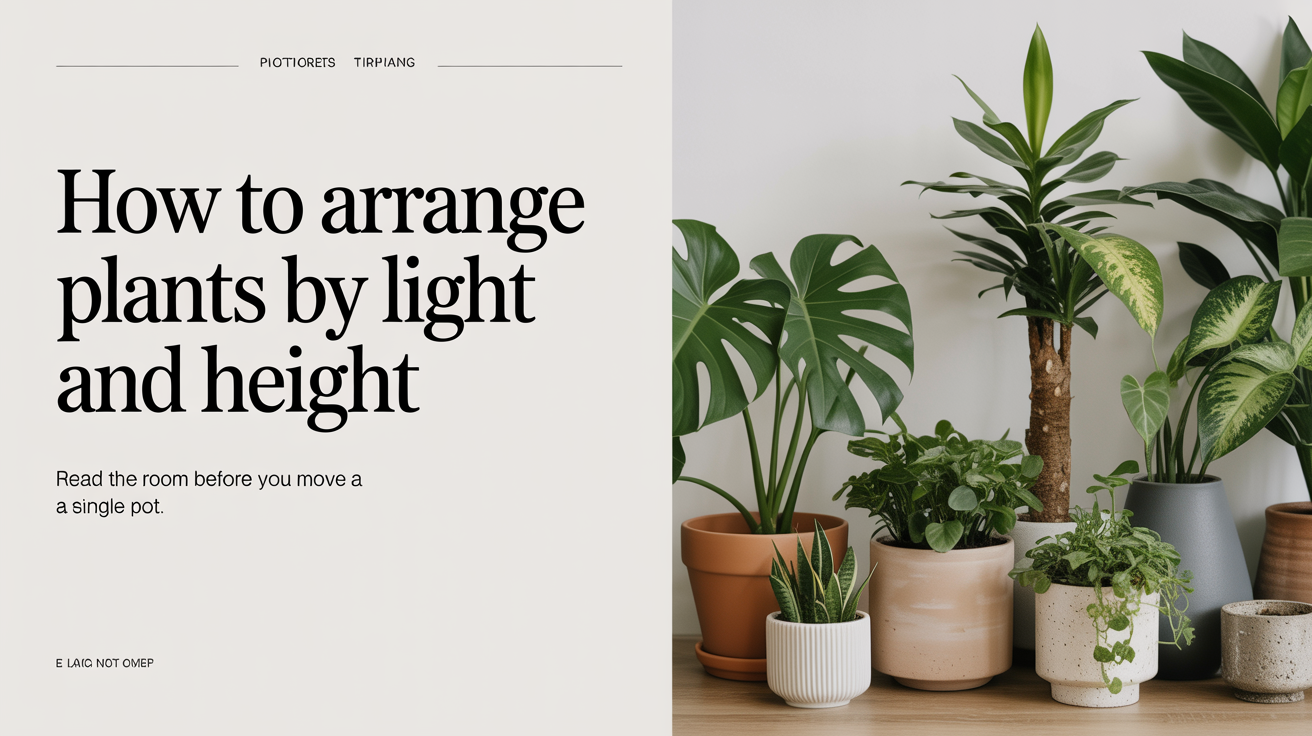
Every arrangement decision starts with light. Before thinking about aesthetics, walk through the space at different times of day and note where direct sun falls, where bright indirect light pools, and where corners stay genuinely dim from morning to evening.
South-facing windows (in the Northern Hemisphere) receive the most consistent light, typically 4-6 hours of direct sun in winter and longer in summer. West-facing windows get strong afternoon sun; east-facing windows offer gentler morning light. North-facing windows stay the dimmest, rarely reaching the threshold most flowering plants need. The University of Maryland Extension's guide to lighting indoor plants puts rough numbers on this: north-facing windows run around 25-100 foot-candles, east and west exposures land in the 100-500 range, and an unobstructed south window can reach 500-1,000 foot-candles, with full direct sun going higher still.
You don't need a light meter, though they cost around $15 and remove all guesswork. A practical test: hold your hand roughly 30 cm (12 in) above a sheet of white paper. A sharp, defined shadow means bright direct light. A soft but readable shadow means bright indirect. A barely-there silhouette means low light. If you want numbers instead of a shadow test, the University of Minnesota Extension's lighting guide measures indoor plant light in micromoles of photosynthetic photon flux, with low light falling around 50-150, medium around 150-250, and high light from roughly 250-450 and up. A cheap phone light meter app won't give you that exact unit, but it will tell you, consistently, whether one spot is brighter than another, which is usually all you need for arranging.
Temperature near windows also varies more than people expect. A tropical plant right against a single-pane window in winter can experience temperatures near 5°C (41°F) on cold nights, even if the room thermostat reads 20°C (68°F). Check by holding your hand near the glass after dark. Sensitive plants should sit a few centimetres back from the glass.
Grouping Plants by Their Light Needs
Once you know your light zones, grouping plants by light becomes the organizing principle of any arrangement. Placing a cactus in a dim corner and a nerve plant on a sun-baked sill are both reliable ways to lose plants quickly.
High-Light Zone (Direct Sun or Very Bright Indirect)
Plants that belong here include most cacti, succulents, jade plants, and crotons. These plants want at least 4-6 hours of direct sun daily, or a position right at a south or west window where light intensity stays high. Watering for most succulents in this zone runs every 10-14 days in summer, less in winter when growth slows.
Heat matters here too. A west window in summer can push daytime temperatures past 35°C (95°F) on the glass itself. Cacti tolerate this fine; thin-leaved plants like ferns will scorch and collapse within days.
Medium-Light Zone (Bright Indirect)
This is the most forgiving zone and the one where most popular houseplants live comfortably: pothos, philodendrons, monsteras, snake plants, and peace lilies. Bright indirect light means sitting within 1-2 metres of a window but out of any direct beam.
Snake plants handle neglect well here, needing water only every 2-3 weeks. Pothos and philodendrons want water when the top 3-5 cm (1-2 in) of soil is dry, usually every 7-10 days in spring and summer.
Low-Light Zone (Dim Corners and Interiors)
Low-light plants tolerate conditions well away from windows, though "low light" never means no light. ZZ plants, cast-iron plants, and some dracaenas manage dim interiors. Water ZZ plants only when the soil is completely dry, roughly every 3-4 weeks.
Avoid the temptation to fill dark corners with flowering plants or anything variegated. Variegated leaves need more light to support photosynthesis across patterned tissue; the Minnesota extension guide notes that a variegated plant kept in insufficient light will often revert toward solid green as the plant prioritizes chlorophyll-rich tissue over the patterned kind. Put one in low light and expect that fade within a few months.
Quick Reference: Matching Light Zone to Plants and Watering
| Light Zone | Typical Position | Approx. Light Level | Example Plants | Typical Watering Rhythm |
|---|---|---|---|---|
| High light | Right at an unobstructed south or west window | 500-1,000+ FC (250-450+ PPF) | Cacti, succulents, jade, croton | Every 10-14 days in summer |
| Medium light | Within 1-2 m of a window, out of direct beam | 100-500 FC (150-250 PPF) | Pothos, philodendron, monstera, peace lily | Every 7-10 days in spring/summer |
| Low light | Interior corners, away from windows | 25-100 FC (50-150 PPF) | ZZ plant, cast-iron plant, some dracaena | Every 3-4 weeks |
Layering Houseplants by Height
Light zoning tells you which plants belong in which part of the room. Layering by height determines how they sit relative to each other, and it's what separates a cluttered windowsill from something that looks genuinely considered.
The basic principle is the same one used in outdoor garden borders: tall plants at the back or center, medium plants in the middle, and low or trailing plants at the front or edges.
Tall Plants (60 cm and Above)
Floor-standing plants create the vertical anchors of any arrangement. Fiddle-leaf figs can reach 1.5-2 m (5-6 ft) indoors. Dracaena marginata grows slowly to similar heights and tolerates lower light than the fiddle-leaf. Bird of paradise needs full sun and warmth (minimum 15°C / 59°F) but rewards the right placement with dramatic paddle-shaped leaves.
Use tall plants to fill dead wall space, break up plain corners, and draw the eye upward. A single tall plant does more visual work than five small ones crowded together at bench height.
Medium Plants (20-60 cm)
Most potted plants on shelves, tables, and stools fall into this category. This is where interesting foliage textures and colors carry the arrangement. Varying heights within this tier matters too. A group of three plants all sitting on the same flat surface at identical pot heights looks static. Raise one on a small stool, let another trail slightly lower, and the same plants become visually dynamic. Plant stands do this work efficiently and come in single-tier and multi-tier versions that add height without taking extra floor space.
Low and Trailing Plants (Under 20 cm or Cascading)
Groundcover-style plants and trailers fill the foreground of arrangements and soften shelf edges. String of pearls, peperomia, small ferns, and fittonias all stay compact. Trailing pothos or heartleaf philodendron draped down from a high shelf add vertical interest in reverse, filling space between a shelf and the floor.
For rooms with minimal floor and shelf space, trailing plants hung overhead extend the arrangement into unused vertical zones. Hanging plants work well in small spaces, especially in corners where no surface exists to place a pot.
Practical Plant Arrangement Ideas for Real Rooms
Knowing the principles is one thing; applying them in a room with awkward windows, radiators, and limited surfaces is another.
Work with the light first, aesthetics second. If your best light is a single east-facing window, group your bright-light plants there even if it means a crowded windowsill. A healthy plant in the wrong spot for your taste beats a styled arrangement where everything struggles.
Odd numbers tend to feel more natural than even ones. Groups of three or five are less rigid than pairs. This isn't a rule to follow rigidly, but if an arrangement looks static, splitting an even number into a triangular formation often resolves it.
Repeat one element to create cohesion. This could be pot material (all terracotta, or all matte white), foliage color (a thread of deep green running through a shelf of varied plants), or leaf shape. A shelf with six different pot styles in six different materials looks like a random collection; a shelf where most pots share a material looks considered.
Mind the air circulation. Plants packed tightly together share humidity, which some tropical plants appreciate, but poor air movement also favors fungal issues and pest problems. Leave a few centimetres between pots.
Don't forget negative space. Leaving gaps in an arrangement (empty shelf space, a bare wall section next to a cluster of plants) makes the plants themselves stand out more. A grouping surrounded by breathing room reads as intentional; a shelf stuffed to the edges reads as storage.
Worked example: a 2 m windowsill. Say you have one south-facing sill roughly 2 m long. A workable layout: a tall dracaena at one end for height, three medium pothos or peperomia plants staggered on small risers across the middle third, and a trailing string of pearls or pothos cascading from the other end. That's five plants total, three heights represented, and roughly 15-20 cm of clear glass left between clusters so no single plant blocks light from another.
For more on how individual styling choices fit into a complete room look, styling houseplants like a designer covers composition, color, and the small decisions that make a display feel finished rather than assembled.
Frequently Asked Questions
Can I mix plants with different light needs in the same arrangement?
Yes, but only if the spot satisfies the highest-demand plant in the group. If a cactus and a pothos are grouped together, the cactus sets the minimum light requirement, and the pothos (which tolerates lower light) simply gets more than it strictly needs. Problems come from compromising in the other direction, placing a sun-lover where only shade-tolerant plants would survive.
How do I stop a plant arrangement from looking cluttered?
Clutter usually comes from too many plants at the same height and too many competing pot styles. Reduce the number of distinct pot materials to one or two, vary heights deliberately, and leave some negative space rather than filling every gap. Removing one or two plants from a crowded shelf often makes the remaining ones look better.
Should tall plants always go at the back?
In a shelf arrangement viewed from one side, yes. Against a wall or in a corner, yes. A free-standing arrangement in the center of a room benefits from tall plants in the center with height stepping down toward all edges, so the display works from every direction.
How often should I rotate plants in an arrangement?
Every 2-4 weeks is a reasonable rhythm for most houseplants. Plants grow toward light, so a plant that stays in one position develops a lean over time. Rotating it regularly keeps growth more symmetrical. Marking one side of the pot with a small piece of tape helps you remember which direction to turn it each time.
What should I do when a plant outgrows an arrangement?
Repot into the next size up (typically 2-5 cm / 1-2 in larger in diameter) in spring, or propagate the plant and return a smaller cutting to the arrangement. Some plants, like pothos, can be kept at a manageable size by trimming regularly. Cuttings root easily in water or moist potting mix, giving you a compact replacement that fits the display again.
My room only has one small window. Can I still build a layered arrangement?
Yes, but the medium and low-light zones will carry more of the display than the high-light zone. Put your one or two sun-lovers directly on the sill, then build the rest of the arrangement outward with bright-indirect and low-light plants at increasing distance from the glass. A small clip-on grow light aimed at a shelf a few feet from the window can effectively create a second medium-light zone if you want more flexibility than the window alone allows.
Do I need to reorganize the whole arrangement seasonally?
Partially. As light angles drop in autumn and winter, a spot that qualified as medium light in summer can slide toward low light. Plants that were thriving 1-2 metres from the window in July may need to move closer to the glass by December. Treat your light zones as approximate and check them again each season rather than assuming a spot stays constant year-round.