Styling & Display
How to Style Houseplants Like a Designer
Learn how to style houseplants with pro plant styling tips: grouping, height, pots, and where to put plants in a room.
Decorating with houseplants isn't complicated, but it does require a bit of intention. The difference between a room that feels lush and considered and one that just has "a plant in the corner" usually comes down to a handful of decisions: scale, grouping, pot choice, and where you actually put things. Here's how to approach it the way a good interior designer would.
At a Glance
- Read the room's light before picking a plant. Light determines what will actually survive, and that should shape your style choices, not the other way around.
- Work in three height layers (floor, tabletop, elevated or hanging) to keep a space visually balanced instead of flat.
- Vary shape and silhouette when grouping, but keep the pot material and color family consistent so the group reads as one decision.
- Odd-numbered groupings (three or five) tend to look more curated than even ones.
- Size the pot to the root ball, not the look you want. An oversized pot holds excess moisture and invites root rot.
- Check toxicity before bringing a new plant into a home with pets or young children. Many popular species, including pothos, monstera, and peace lily, are on the ASPCA's toxic plant list.
Start with the Room, Not the Plant
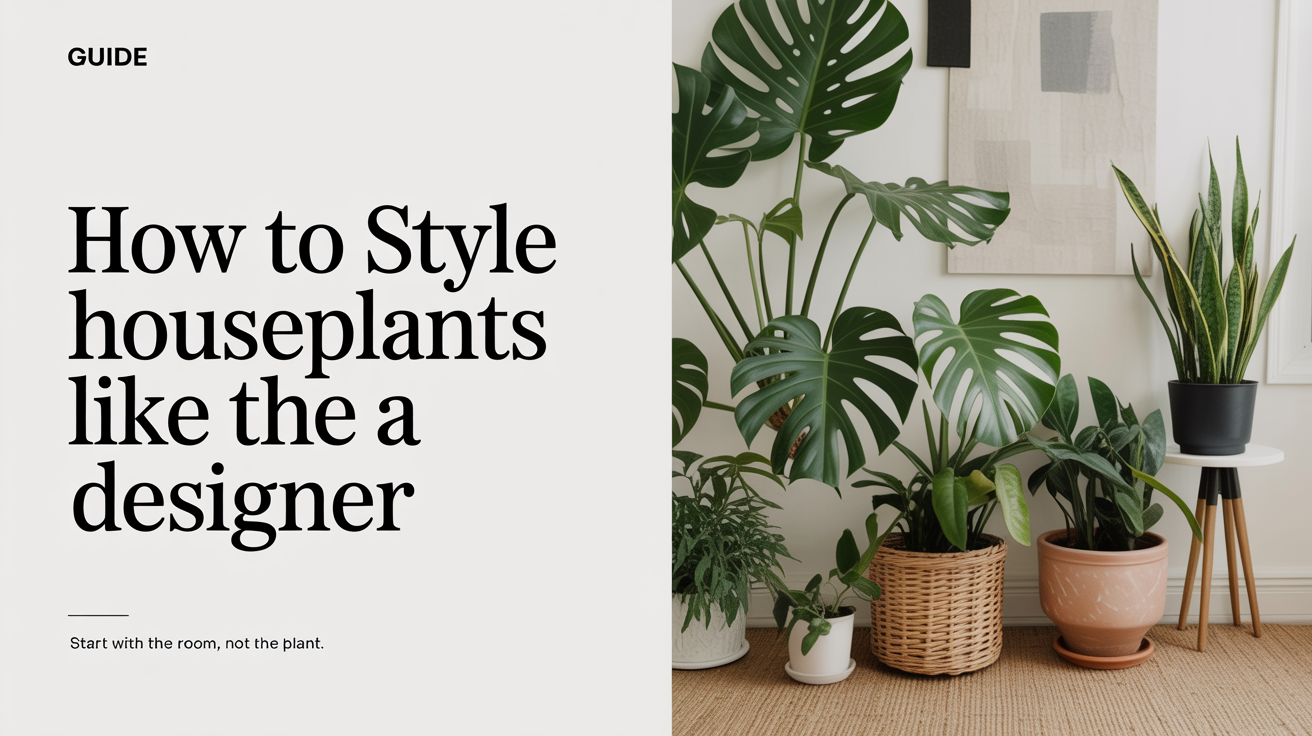
Before you pick a plant, look at the space. Note where natural light comes from and how it moves during the day. A room with a south-facing window gets strong, direct sun for most of the day; a north-facing one stays in indirect light all day. This isn't just about plant survival, it shapes your entire styling palette. Bright rooms open up a wider range of species and let you use sun-loving specimens like Euphorbia trigona or a compact Meyer lemon as a focal point. Low-light rooms narrow your options but still give you genuinely beautiful choices: Zamioculcas zamiifolia (ZZ plant), various Dracaena varieties, and cast-iron plant (Aspidistra elatior) all have strong visual presence.
Also notice your furniture scale. A 6-inch pothos on a massive sideboard reads as an afterthought. A single large plant in a room full of medium-sized furniture commands attention and creates a natural anchor. A rough rule that designers use: a floor plant should reach at least a third of the ceiling height to register as a real piece of furniture rather than an accessory. In a standard 8-foot room, that means looking for something in the 3 to 5-foot range, not a 12-inch starter plant sitting alone on the floor.
Think in Three Heights
One of the simplest plant styling tips designers use is working with three distinct height layers: floor level, tabletop or counter level, and elevated or hanging level. This creates visual rhythm and stops the eye from flattening out.
Floor-level plants
Large specimens work here. A Ficus lyrata (fiddle-leaf fig) at 4 to 5 feet tall, a mature Monstera deliciosa, or a bird of paradise (Strelitzia reginae) planted in a 14-inch or larger pot all create a strong vertical statement. Place these near windows or in room corners where they anchor a seating arrangement without blocking sightlines. NC State Extension's plant profile for Monstera deliciosa notes it prefers moderate brightness rather than direct sunlight, which makes it a good floor plant a few feet back from a bright window rather than pressed against the glass.
Tabletop and counter-level plants
Medium plants at eye level or just below draw the most attention because they sit in your direct line of vision. A Pilea peperomioides on a coffee table, a trailing Scindapsus pictus on a bookshelf, or a small Calathea ornata on a desk all work well here. Keep the pot proportional to the plant: a 4-inch plant in a 6-inch pot looks lost; a tightly rooted 4-inch plant in a 4-inch pot with a good drainage saucer reads as intentional.
Elevated and hanging plants
Plants displayed above eye level add softness to a room without taking up floor space. Trailing plants are especially effective here because the vines hang down and fill vertical space. Epipremnum aureum (golden pothos), Tradescantia zebrina, and string-of-pearls (Senecio rowleyanus) are reliable choices. For ideas on making the most of vertical space, see our guide to hanging plant ideas for small spaces.
How to Group Plants Effectively
A single plant tends to look like an object; a grouping of plants starts to feel like a considered decision. But not all groupings work. Here's what separates a successful cluster from a cluttered one.
Vary size and form, not just species. Put a tall, upright plant (like a Sansevieria trifasciata) next to a round, bushy one (like a Peperomia obtusifolia) and a low trailing one (like a Sedum burrito). The contrast in shape and silhouette does the visual work.
Stick to a pot palette. Three plants in three different pot styles, one terracotta, one wicker, one glazed teal, will fight each other. Pick a material or a color family and stay in it. Terracotta plus natural fiber is an easy pairing. Matte whites and off-whites work with almost any plant.
Odd numbers read as curated. A group of three or five tends to look more considered than two or four. Two plants of similar size just look like a matched set; that can work, but it's a different visual effect.
Leave some negative space. Don't pack plants so tightly that none can be seen clearly. Each plant should be able to "breathe" visually, with some visible space between pots. As a working measure, aim for at least a hand's width of visible gap between the widest points of neighboring plants in a grouping of three or more.
Where to Put Plants in a Room
This is one of the most common questions in plant styling, and the answer depends on both light and function. Here's a quick-reference guide:
| Room / Location | Best Conditions | Good Species |
|---|---|---|
| South-facing living room | Bright direct sun several hours/day | Euphorbia, cacti, citrus, Sansevieria |
| North-facing bedroom | Indirect, lower light | ZZ plant, cast-iron plant, pothos |
| Bathroom with window | Humid, medium indirect light | Ferns, Spathiphyllum, Tradescantia |
| Kitchen counter | Variable, often warm and dry | Herbs, small succulents, Peperomia |
| Home office desk | Medium indirect light | Pilea, Pothos, Chlorophytum comosum |
| Hallway or entryway | Often low light, dry | ZZ plant, cast-iron plant, snake plant |
A few notes on specific rooms:
Bathrooms with a window are underused plant spaces. The humidity from showers benefits moisture-loving plants like Boston fern (Nephrolepis exaltata), peace lily (Spathiphyllum wallisii), or Asplenium nidus (bird's nest fern). Without a window, skip it, low-light plants still need some light.
Entryways are tricky because light is often genuinely dim and temperature fluctuates near the door. Stick to very tolerant species and avoid anything that sulks with temperature swings.
Pot Selection and Surface Styling
The pot is a design object as much as the plant is. A few principles worth following:
Pot size should match root ball, not desired height. Going too large causes soil to stay wet too long between waterings, which leads to root issues. Most plants do best with just 1 to 2 inches of space around the root ball. Clemson HGIC's repotting guidance recommends selecting a pot only 1 to 2 inches larger in diameter than the current one for exactly this reason, which is a useful number to have in mind when a beautiful oversized pot is tempting at the garden center.
Drainage matters for styling too. Cachepots (decorative outer pots with no drainage hole) let you use beautiful containers while keeping a practical nursery pot inside. Just remove the nursery pot to water, let it drain, and drop it back in. This avoids drilling holes in expensive ceramics.
Saucers. A well-chosen saucer completes the look; a mismatched one undermines it. Marble saucers, cork trivets, and wooden platforms all work as risers that add height variation on a tabletop surface.
For building out a display with multiple plants at varying heights, consider dedicated stands rather than repurposing furniture. Our roundup of plant stand ideas to show off your collection covers options from simple wood risers to tiered metal frames.
Pot Material at a Glance
Material choice affects both the look and how forgiving the plant is to care for. This comparison covers the trade-offs:
| Material | Drainage/dry-out speed | Weight | Best paired with | Watch for |
|---|---|---|---|---|
| Terracotta (unglazed) | Fast, porous walls wick moisture out | Light to medium | Succulents, cacti, plants prone to overwatering | Cracks in freezing outdoor temps; can look chalky over time |
| Glazed ceramic | Slow, non-porous | Heavy | Tropical foliage that likes even moisture | No drainage hole on many decorative pieces; verify before buying |
| Concrete or stone | Slow to moderate | Very heavy | Large floor specimens, minimalist rooms | Hard to move once planted; needs a true drainage hole |
| Plastic nursery pot inside a cachepot | Depends on the nursery pot | Very light | Any plant, especially frequently rotated collections | Looks utilitarian alone; always pair with a decorative outer pot |
| Woven natural fiber (rattan, seagrass) | Neutral, usually holds a plastic liner | Light | Boho or textured interiors, hanging displays | Fiber degrades with direct water contact; keep the liner watertight |
Building a Plant Corner
A dedicated plant corner is one of the most satisfying things to put together in a home, but it benefits from a deliberate starting point rather than just accumulating plants.
Choose the corner based on light, not aesthetics. A gorgeous corner with no natural light will look great for a week and then start looking tired as plants struggle. Once you've confirmed a workable light level, start with one large anchor plant, one medium plant at a different height, and one trailing or low plant. Let those three settle for a few weeks before adding more.
Resist the urge to fill every surface. The best-looking plant corners have some open wall visible, some visible floor, and plants that are spaced so each can be seen individually. See our deeper guide on how to create a plant corner that looks intentional for a step-by-step approach.
One note on plant safety: Many common houseplants are toxic to cats, dogs, and children. Monstera, Pothos, Dieffenbachia, and peace lily are among the frequently used species that are harmful if ingested. The ASPCA's toxic and non-toxic plant list is the standard reference for checking a specific species before buying, and it maintains separate lists for dogs, cats, and horses since sensitivity varies by animal. Its entry for pothos, for example, lists oral irritation, drooling, and vomiting as the typical symptoms from chewing the leaves. This is informational, not a substitute for veterinary guidance. If a pet or child ingests a houseplant and shows symptoms, contact a veterinarian, pediatrician, or poison control promptly rather than waiting to see if it passes. Before bringing any new plant home, verify its toxicity status and keep problematic species out of reach, on a high shelf or in a room pets don't access.
Frequently Asked Questions
How many plants is too many in one room?
There's no fixed number, but the room should still feel like a room, not a greenhouse. A practical check: if you can't easily see each plant individually, the room may be over-planted. The quality and scale of each plant matters more than the count.
Should all my plant pots match?
They don't need to be identical, but they work best when they share something: a material (terracotta throughout), a color temperature (all neutrals or all earth tones), or a general style (handmade ceramics). Strict matching can look rigid; zero coherence looks random.
My room doesn't get much natural light. What are my options?
True low-light plants do exist: ZZ plant, cast-iron plant, and certain Dracaena varieties tolerate dimmer conditions. Supplemental grow lights (full-spectrum LED panels or bulbs) can also genuinely extend what's possible, especially for a dedicated plant shelf or corner away from windows.
What's the easiest way to add a large plant on a budget?
Buy young. A 6-inch Monstera deliciosa costs a fraction of a 3-foot specimen and will grow noticeably in a single growing season with good care. Starting small also lets you learn a plant's needs before committing to a large pot that's harder to adjust.
Does the color of the pot affect the plant?
Functionally, yes in some cases: dark pots absorb more heat in direct sun, which can dry soil faster and affect root temperature. Terracotta is porous and dries faster than glazed ceramic. These are minor considerations for most interior settings, but worth knowing if you're placing something in a warm, sunny spot.
Which houseplants are considered pet-safe if toxicity is a concern?
Spider plant (Chlorophytum comosum), Calathea varieties, most Peperomia, parlor palm (Chamaedorea elegans), and Boston fern are commonly listed as non-toxic options on the ASPCA's plant database. That said, "non-toxic" doesn't mean risk-free for curious pets that dig in soil or chew leaves for texture, so keeping any plant out of easy reach is still worth doing in a multi-pet household.
How do I style a rental where I can't drill into walls?
Lean on freestanding stands, tiered plant tables, and tension rods that wedge into a doorway or alcove without hardware. Command-style hooks rated for the plant's potted weight can hang lighter trailing plants from a ceiling or curtain rod. Save wall-mounted shelves for a home you own, or confirm with a landlord first, since a fully loaded shelf puts real ongoing weight on whatever it's anchored to.