Propagation
Soil vs Water Propagation: Which Works Better
Comparing water vs soil propagation for houseplants: how each method works, which plants prefer which, and how to transplant water cuttings to soil.
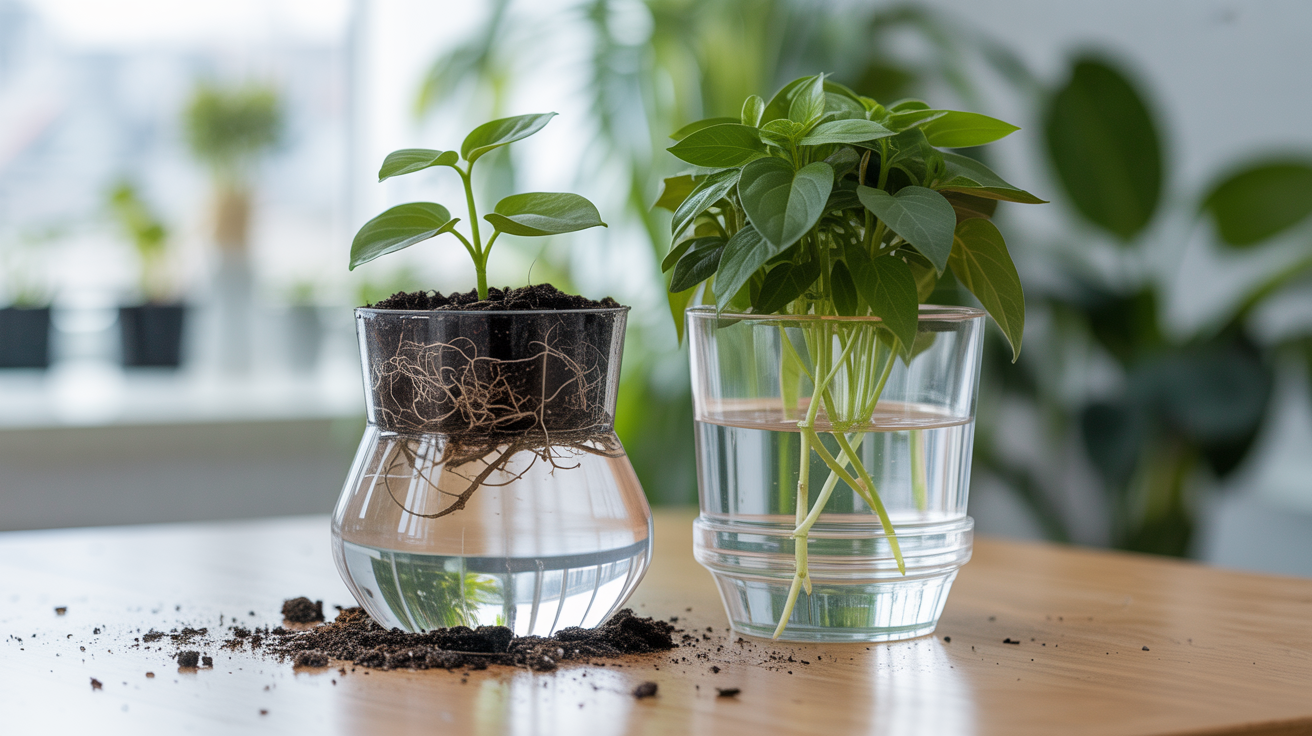
Both water and soil propagation work. The honest answer to which is better depends on the plant you are taking a cutting from, how much attention you want to pay in the first few weeks, and what you plan to do with the new plant once it has roots. Neither method is universally superior, but each has clear situations where it pulls ahead.
Here is how both approaches actually work, where each one tends to fail, what a realistic week-by-week timeline looks like, and how to move a water-rooted cutting into soil without losing the progress you have already made.
At a Glance
- Water propagation is easiest to monitor and works well for soft-stemmed tropicals like pothos, philodendron, and tradescantia, often rooting within two to four weeks.
- Soil propagation scales better and is the only reliable option for succulents, cacti, and plants that resent root disturbance, such as fiddle-leaf fig.
- The longer a cutting stays in water, the more its roots specialize for a liquid environment, which makes a later move to soil harder. Pot up water roots while they're still short, around 2-5 cm (1-2 in).
- Rooting hormone is optional for easy plants and most useful for woodier cuttings that root slowly in either medium.
- A humidity dome or loosely draped plastic bag speeds up soil rooting substantially by keeping moisture around a cutting that has no roots yet to replace what it loses through its leaves.
How Water Propagation Works
You place a stem cutting, with one or two nodes below the waterline, in a glass or jar. Roots emerge from the node over the course of one to four weeks, depending on the plant and the temperature in your space. University of Nevada, Reno Extension notes that easy rooters like pothos and philodendron can show roots within ten days under good conditions.
The roots that form in water are structurally different from the roots that form in soil. Water roots are smoother, more pliable, and adapted to pulling oxygen and nutrients from a liquid environment. They have fewer root hairs than soil-grown roots. That distinction matters later, when it is time to move the cutting.
What makes water propagation useful
Watching roots grow through a clear glass is the most reliable way to know that propagation is actually working. You do not have to guess or tug gently on the cutting and hope for resistance. You can see the progress.
Water propagation is also forgiving for beginners. Cuttings submerged in fresh water do not dry out the way they can in soil, and there is no risk of overwatering in the traditional sense. A clean jar and a bright windowsill (out of direct sun) are the only requirements.
Most soft-stemmed tropical houseplants root readily in water. Pothos, philodendrons, tradescantia, begonias, impatiens, coleus, and many aroids all develop visible roots within two to four weeks at room temperature, ideally somewhere between 18°C and 24°C (65°F and 75°F). University of Nevada, Reno Extension lists creeping charlie, pothos, and several philodendrons by name as reliable water rooters.
Where water propagation falls short
Water is not a free lunch. The longer a cutting stays in water, the more those specialized water roots adapt to that environment. Moving a cutting after ten weeks in a jar is harder than moving one after three, because the roots have become highly adapted to low-resistance, oxygen-rich water and struggle to take up moisture from dense, compact soil. University of Nevada, Reno Extension puts it plainly: cuttings may suffer or go into shock when moved from water into soil, which is exactly why the timing of that move matters as much as the rooting itself.
Water propagation also does not scale well. One jar with one cutting is fine. Thirty jars on a windowsill is a different project. And certain plants, particularly succulents, cacti, and anything with woody stems, either rot in water or simply never produce roots this way. Not all plants root in water at all, no matter how long you wait.
How Soil Propagation Works
You insert a cutting (or lay a leaf, in the case of succulents) into a rooting medium and keep the medium lightly moist while the cutting forms roots on its own. The most common media are perlite, coarse horticultural sand, a 50/50 mix of perlite and potting soil, or a dedicated propagation mix.
The roots that form go directly into a solid medium. They develop root hairs right away and are already calibrated to pulling water from particles rather than a free liquid. When you eventually pot the cutting up, there is no transition shock to navigate. The plant is already living in the right environment.
What makes soil propagation useful
Soil-rooted cuttings tend to establish faster after potting than water-rooted ones do. The roots are already doing the right kind of work, so moving the cutting into a larger pot is essentially a continuity, not a change. This matters most for plants that resent root disturbance, such as rubber plants (Ficus elastica), fiddle-leaf figs, or plants with thick, fleshy stems.
Succulents and cacti almost always need soil propagation, and leaf cuttings are the standard method. NC State Extension's profile of jade plant, a common succulent, confirms this directly: propagation is easily achieved by leaf cutting. Their leaves and pads are susceptible to rot in standing water, and their preferred rooting medium is extremely dry, so perlite or coarse sand works far better than a glass of tap water. For a full walkthrough on this group, how to propagate succulents from leaves and cuttings covers the process step by step.
Soil propagation is also the right choice when you are trying to propagate a large number of cuttings from one plant. You can fill a single tray with propagation mix, insert dozens of stem cuttings, cover the tray with a humidity dome or a sheet of clear plastic, and let them root together without managing individual water vessels.
Where soil propagation falls short
The main issue is that you cannot see what is happening. Rooting in soil requires patience and some trust. Tugging the cutting after a week to check for resistance works but damages fragile new roots if they have started to form.
Keeping the medium at the right moisture level also takes practice. Too wet and the stem rots. Too dry and the cutting desiccates before roots form. A light mist every two to three days, combined with bottom watering if the tray allows it, usually keeps things in the right range. Humidity helps too. Keeping the air around the cutting at 60 to 70 percent relative humidity noticeably speeds rooting and reduces wilting while the cutting has no root system to support it.
Rooting hormone is more relevant here than it is in water. University of Illinois Extension recommends dipping cuttings in rooting hormone powder before planting to encourage development, but cautions that excess powder on the cutting will actually hinder root growth rather than help it. A light dusting, tapped off before planting, is enough.
Matching Method to Plant
Not every plant prefers the same route. Here is a general breakdown, including a rough sense of how long rooting itself takes once you've started:
| Plant type | Best method | Notes | Typical time to root |
|---|---|---|---|
| Pothos, philodendron, tradescantia | Either | Water is easiest to monitor | 1-3 weeks in water |
| Succulents and cacti | Soil (dry perlite or sand) | Water causes rot | 2-6 weeks, callus first |
| Rubber plant, fiddle-leaf fig | Soil | Sensitive to transplant shock | 4-8 weeks |
| Begonias, coleus, impatiens | Water or soil | Both work reliably | 2-4 weeks |
| Rosemary, basil, mint | Water first, then pot up early | Move to soil while roots are still short | 1-3 weeks |
| ZZ plant, sansevieria | Soil (or water, slowly) | Soil gives more consistent results | 4-10 weeks |
Pothos is one of the few plants that does equally well in either direction. If you are new to propagation, it is the best plant to practice both methods on before trying something more particular. How to propagate pothos, a beginner's guide goes into more detail on node placement and timing.
What to Expect Week by Week
Real propagation rarely follows a perfectly even timeline, but knowing roughly what stage you should be at helps you tell normal progress from a stalled cutting.
| Timeframe | Water propagation | Soil propagation |
|---|---|---|
| Week 1 | No visible change yet; the cut end may callus slightly under the waterline | The cutting may wilt somewhat; a callus forms over the cut end |
| Week 2 | Small white root nubs appear at the submerged node | No visible change above soil; fine root hairs may be forming below |
| Weeks 3-4 | Roots reach 2-5 cm (1-2 in), the window to pot up before they specialize too far | A gentle, light tug shows resistance; new top growth may start to appear |
| Week 5 and beyond | Roots left in water much longer become highly water-adapted and transplant less easily | The cutting can move to a slightly larger pot; steady new growth follows |
How to Transplant Water Cuttings to Soil
Moving a cutting from water to soil is one of the places where propagation most often goes wrong. The roots have adapted to water, and the sudden change in environment stresses them. A gradual transition reduces that stress considerably.
Step one: move early
The single most effective thing you can do is pot up your water-rooted cuttings while the roots are still relatively short, around 2 to 5 cm (roughly 1 to 2 inches). Long, tangled roots are more fragile during the move and have had more time to specialize for water. Shorter roots adapt more readily.
Step two: choose a light medium
Do not move water-rooted cuttings directly into heavy potting soil. Start with something that holds a little moisture but also drains freely, such as a mix of half potting soil and half perlite. This sits between the water environment the cutting came from and the denser soil it will eventually live in.
Step three: keep the medium consistently moist at first
Water-rooted cuttings need more frequent watering than established plants for the first two to three weeks after transplanting. The roots are not yet efficient at pulling moisture from solid particles, so drying out too fast is a real risk. Water every two to three days during this adjustment period, then gradually pull back to a normal schedule as the plant produces new growth, which signals that the root system is functioning well.
Keeping the cutting out of direct sun during this adjustment window also helps. Bright indirect light at 18°C to 24°C (65°F to 75°F) gives the plant a manageable environment while it adapts.
Frequently Asked Questions
Does water propagation produce weaker plants than soil propagation?
Not weaker exactly, but the roots are structurally different. Water roots are adapted to a liquid environment and need time to adjust when they move to soil. Plants started in soil do not have that adjustment period, so they often establish more quickly after potting. Once a water-rooted cutting is fully settled in soil, there is no meaningful long-term difference.
How often should I change the water in a propagation jar?
Change it every five to seven days, or sooner if it looks cloudy or discolored. University of Illinois Extension recommends refreshing the water every three to five days for the fastest, cleanest results. Fresh, room-temperature water keeps oxygen levels higher around the developing roots and reduces bacterial growth. Some growers add a small piece of activated charcoal to keep the water clear between changes.
Can I skip rooting hormone for both methods?
Rooting hormone (powder or gel form) is optional for soft-stemmed plants that root easily in water or soil. It makes a more noticeable difference for woodier cuttings or plants that are slow to produce roots, such as rubber plants or rosemary. For pothos, philodendrons, or tradescantia, you can skip it without any meaningful impact on success rate. It's also largely wasted on water propagation, since the powder dissolves and washes away quickly in a jar rather than staying in contact with the cut end the way it does in a solid medium.
Which method is better if I want multiple plants quickly?
Soil propagation scales more easily. A single tray of propagation mix holds dozens of cuttings and takes up less space than managing many individual water containers. If speed per cutting is the priority and you are only doing a few, water gives you the fastest visible feedback for compatible plants. For the full steps involved in water propagation, how to propagate plants in water, step by step walks through the process.
Why is my soil cutting wilting even though it has been a week?
Wilting in the first one to three weeks is normal. The cutting has no root system yet to replace water lost through its leaves, so it relies on the humidity around it and on whatever moisture it can absorb through the cut stem end. A clear plastic bag loosely draped over the cutting, or a humidity dome if you are using a propagation tray, traps enough moisture to reduce wilting significantly while roots form. Once new leaves appear, the roots are established enough to support the plant on their own.