Propagation
Why Your Cuttings Aren't Rooting (and How to Fix It)
Cuttings not rooting? Learn the most common reasons propagation stalls and the specific fixes that get stems rooting in water or soil.
Cuttings not rooting is one of those problems that feels mysterious until you realize there are only a handful of things that actually go wrong. A stem sitting in a jar of water for six weeks without a single root is not a sign of hopeless plant parenthood. It usually points to one fixable condition: wrong temperature, a missing node, too much rot in the water, or simply not enough time. Work through the checklist below and you will almost certainly find the cause.
At a Glance
- No node below the waterline means no roots, ever. This is the single most common beginner mistake, and it has nothing to do with skill.
- Temperature between 65°F and 75°F (18°C and 24°C) speeds rooting more than almost any other single factor.
- Most cuttings take 2 to 8 weeks; slow rooters like hoya can take 10 to 12 weeks.
- Rot almost always traces back to a submerged leaf, stagnant water, or a jar in direct sun, not a "bad" cutting.
- Rooting hormone shortens the wait for slow rooters but cannot rescue a cutting sitting in cold, dark, or dirty water.
- Different plants root better in different mediums (water, perlite, sphagnum moss, or soil), so switching medium is often the fix for a stalled cutting.
The Most Common Reasons a Cutting Won't Root
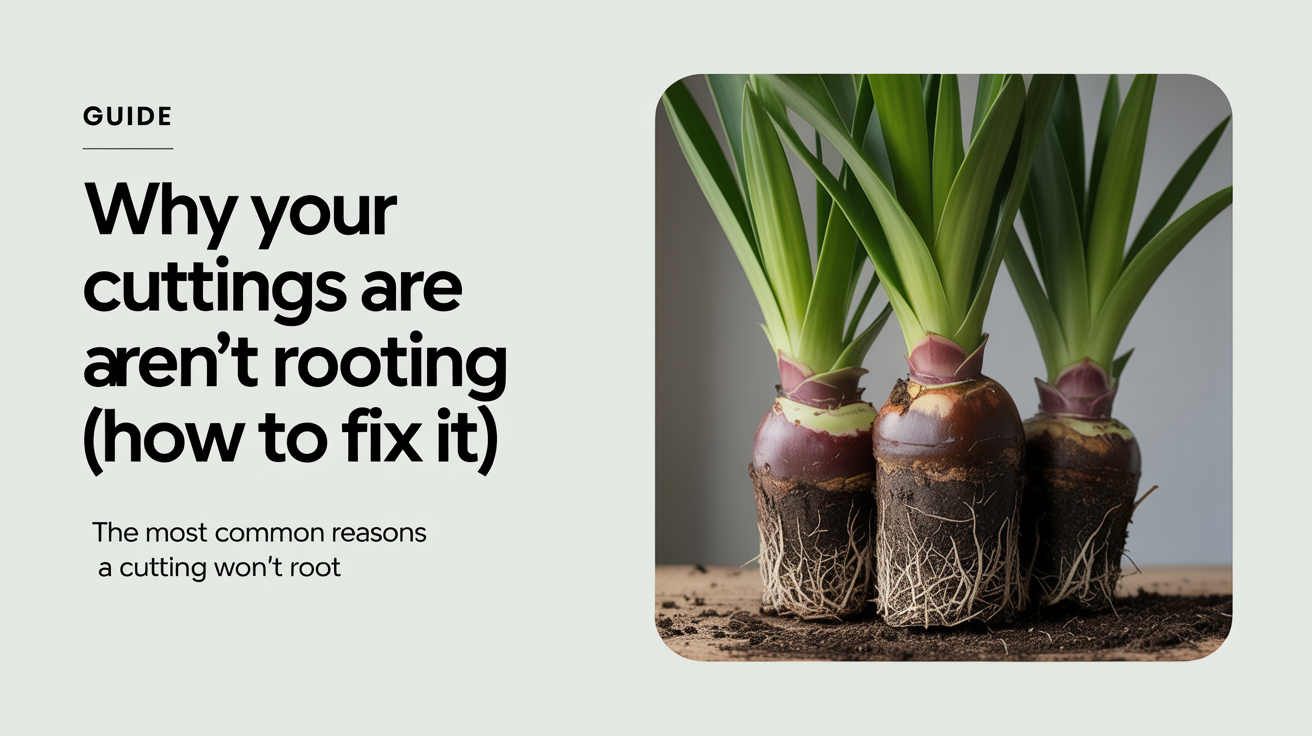
The Node Is Missing
Every cutting needs at least one node. Nodes are the slight bumps or joints on a stem where leaves and roots both originate. A section of smooth stem between two nodes will never produce roots, no matter how long it sits in water or perlite. Before you take a cutting, identify the nodes and make sure at least one ends up below the waterline (or below the soil surface). For most houseplants, one or two nodes is enough. If you're not confident identifying a node on the plant you're working with, how to take a healthy stem cutting shows exactly what to look for before you make the cut.
The Cutting Is the Wrong Length
Longer is not always better. A cutting that is eight or ten inches long has a lot of tissue to support before any roots form, which puts it under stress early. Three to five inches is a reliable general range. Anything shorter than two inches often dries out or rots before it can establish, especially in soil.
The Cut Itself Was Sloppy
A dull blade crushes the cells at the cut end rather than slicing cleanly through them. Those crushed cells are slower to callous, more prone to rot, and less able to absorb water. A sharp blade, cleaned before each use, makes a real difference. Wipe the blade with rubbing alcohol between plants, especially if you're taking cuttings from more than one specimen, since a dirty blade can spread disease along with the cut. Cut at a slight angle to increase the surface area exposed to the rooting medium.
Temperature and Light: The Two Conditions Most People Overlook
Temperature
This one causes more failed propagations than almost anything else. Roots develop fastest when the rooting medium sits between 65°F and 75°F (18°C and 24°C). A jar of water sitting on a cold windowsill in autumn can easily drop to 55°F (13°C) or below, effectively pausing root development. If your home runs cool, a seedling heat mat set to 70°F (21°C) under the rooting container can cut several weeks off the process.
Light
A cutting needs energy to build new cells, so it needs some light. But it also has no roots to replace moisture lost through its leaves, so direct sun is too stressful. Bright indirect light is the right balance: an east-facing windowsill, or a spot two to three feet back from a south or west window. Deep shade will slow root development noticeably.
Why Your Cutting Is Rotting Instead of Rooting
Rot in water propagation is frustrating precisely because the cutting often looks fine right up until it collapses. Most cases trace back to one of three causes.
Leaves Below the Waterline
Any leaf sitting in the water will begin to decompose within a week or two. The bacteria that break down the leaf will then attack the stem. Strip every leaf from the bottom two inches of the cutting before it goes into the jar. Nothing should touch the water except the bare stem.
Stagnant Water
Still water grows bacteria quickly, especially at room temperature. Change the water every five to seven days, or sooner if it starts to look cloudy or develops a smell. This single habit prevents most water-propagation rot.
The Wrong Container
A large clear jar in direct sunlight becomes a petri dish. Heat plus light triggers algae blooms, and algae uses up the oxygen in the water. A dark-colored glass jar (or a clear jar wrapped in paper) in indirect light is a much better setup. Smaller containers are also easier to keep clean.
How Rooting Hormone Works (and When It Actually Helps)
Rooting hormone is a synthetic version of auxin, a plant hormone that, according to Wikipedia's summary of the plant-hormone literature, "promotes root initiation" and drives both new root growth and root branching. Commercial rooting products use synthetic versions of auxin (commonly IBA or NAA) for exactly this reason. Dipping the wet cut end of a stem into rooting hormone powder or gel before placing it in the rooting medium can speed things up, sometimes by two to four weeks, for plants that are slow to root on their own.
The catch is that rooting hormone cannot fix bad conditions. A cutting in cold, dark water will still fail with rooting hormone applied. It is most useful when your other conditions are correct and you want to shorten the wait, or when you are propagating a plant with a reputation for slow rooting, like hoya, gardenia, or anything with a woody stem.
For powder forms, the method matters. Wet the cut end first, dip it briefly into the powder, then tap off any excess. Too much powder coats the cells and can actually prevent rooting rather than speed it.
Pothos, philodendron, tradescantia, and most aroids root readily without any hormone at all. The NC State Extension profile for pothos notes that vine cuttings root in water in about two weeks under good conditions, which is about as fast as houseplant propagation gets. Propagating pothos in particular is forgiving and a good starting point if you want to practice the basics.
Choosing the Right Rooting Medium
The medium the cutting sits in matters more than most beginners expect. Switching mediums is often the simplest fix for cuttings that have stalled. The University of Illinois Extension's guide to houseplant propagation notes that cuttings rooted in solid media like perlite or vermiculite often develop sturdier root systems than water-rooted cuttings, which can struggle a little when they're first transitioned to soil.
Water works well for pothos, philodendron, tradescantia, impatiens, and most aroids. The advantage is that you can watch the roots form. The disadvantage is that water roots are structurally different from soil roots, so there is always a transition period when you pot them up. Our side-by-side comparison of soil versus water propagation covers which plants do better in each and why.
Perlite stays airy and gives roots access to oxygen while still holding enough moisture. Plants that tend to rot in water, including many hoyas and stem cuttings from thick-stemmed plants, often respond better to perlite than to water.
Sphagnum moss wraps the node in humidity without waterlogging it. Good for monsteras, climbing philodendrons, and plants that form aerial roots along their stems. Propagating a monstera from a cutting walks through the sphagnum moss method step by step.
Potting mix works for a wide range of plants, but the soil has to stay consistently moist without becoming waterlogged. A clear plastic bag loosely tented over the cutting and pot holds in humidity and reduces how often you need to water.
If a cutting consistently fails in one medium, try a different one before concluding the plant is at fault.
How Long Should You Actually Wait?
Impatience accounts for a large share of propagation failures. Most houseplant cuttings take two to eight weeks to form visible roots. Slow rooters like hoya can take ten to twelve weeks from cut to visible root tips.
Pulling a cutting out of perlite or soil every few days to check for roots destroys any roots that have started forming. For water propagation, you can simply look through the glass. For soil and perlite, try a gentle tug after three or four weeks: if the cutting resists, roots are there.
New leaf growth is a reliable indicator that rooting is underway. A stem that pushes out even a small new leaf is photosynthesizing and allocating energy, which means the root system is developing below the surface. A green, firm stem that shows no new growth but no collapse is also fine; it is probably just working slowly.
For a full walkthrough of getting multiple plant types going at once, how to propagate plants in water step by step goes through the setup in detail.
Typical Rooting Timelines by Plant
Expectations matter as much as technique. The table below gives a rough sense of how long a healthy cutting should take before you start troubleshooting.
| Plant | Typical Medium | Rooting Time | When to Worry |
|---|---|---|---|
| Pothos | Water or soil | 1 to 3 weeks | No roots after 5 weeks |
| Heartleaf philodendron | Water or soil | 2 to 4 weeks | No roots after 6 weeks |
| Tradescantia | Water | 1 to 2 weeks | No roots after 4 weeks |
| Snake plant (leaf cutting) | Water or soil | 4 to 8 weeks | No roots after 10 weeks |
| Monstera | Sphagnum moss or water | 3 to 6 weeks | No roots after 8 weeks |
| Hoya | Perlite or soil | 6 to 12 weeks | No roots after 14 weeks |
Frequently Asked Questions
Why does my cutting look healthy but won't grow roots?
The most common causes are temperature (too cold), a node that is not submerged or buried deep enough, or not enough time. A cutting can look perfectly healthy for three weeks and then push out several roots in a short burst. Confirm the spot is above 65°F (18°C) and that at least one node is below the waterline or soil surface, then give it more time before you write it off.
Does rooting hormone work for all plants?
It helps most plants but is not essential for all of them. Pothos, philodendron, and most fast-rooting houseplants do not need it. Slower rooters like hoya, gardenia, and anything with woody stems respond more noticeably to it. Succulents can sometimes root poorly when hormone is applied at the base of a leaf, so skip it for leaf propagation and use it only for stem cuttings.
My cutting rotted in water. What should I do differently?
Check three things: whether any leaves were touching the water, how often you changed it, and the temperature of the water. A leaf below the waterline is almost always the culprit. Changing the water every five to seven days prevents bacterial buildup. Water that runs too warm, above 75°F (24°C), speeds bacterial growth, while water below 65°F (18°C) slows rooting to a crawl.
Can I move a water-rooted cutting into soil?
Yes, and the timing matters. Wait until the roots are at least half an inch to one inch long before potting up. Move to a well-draining potting mix and water more frequently than usual for the first two weeks to help the cutting adjust. Some drooping and leaf drop during this period is normal.
Why won't my succulent leaf cuttings root?
Succulent leaves need to callous before they can root. A freshly snapped leaf placed straight onto moist soil often rots before the open end can seal. Let the broken end dry in open air for one to three days first, until a dry skin forms over the cut. Then lay the leaf on top of barely damp soil rather than burying it. Propagating succulents from leaves and cuttings covers the specific technique for both methods.
Can a cutting root and then still die afterward?
Yes, though it's less common than failing to root in the first place. A cutting that rooted in water and then rotted after being moved to soil usually got too much water too soon. Water roots have no root hairs and are more fragile than soil roots, so ease off watering slightly for the first week or two after the move rather than treating the transplant like an established plant.